Is He Beefing With Abraham Lncoln
| Bump-off of Abraham Lincoln | |
|---|---|
| Part of the American Civil War | |
 John Wilkes Berth assassinating Abraham Lincoln in Ford's Theatre | |
| Location | Ford's Theatre, Washington, D.C., U.S. |
| Engagement | Apr 14, 1865 (1865-04-14) 10:fifteen pm |
| Target |
|
| Attack type |
|
| Weapons |
|
| Deaths | Abraham Lincoln (died Apr 15, 1865, at 7:22 am from his injuries) |
| Injured | John Wilkes Berth (perpetrator)
|
| Perpetrators | John Wilkes Booth and co-conspirators |
| Motive | Revenge for the Confederate States |
On April fourteen, 1865, Abraham Lincoln, the 16th president of the United States, was assassinated by well-known stage role player John Wilkes Berth, while attention the play Our American Cousin at Ford's Theatre in Washington, D.C. Shot in the head every bit he watched the play,[2] Lincoln died the post-obit day at 7:22 am in the Petersen House opposite the theater.[iii] He was the first U.S. president to be assassinated,[4] with his funeral and burying marking an extended period of national mourning.
Occurring nigh the end of the American Civil War, Lincoln's assassination was part of a larger conspiracy intended by Berth to revive the Amalgamated cause past eliminating the three most important officials of the United states regime. Conspirators Lewis Powell and David Herold were assigned to kill Secretary of State William H. Seward, and George Atzerodt was tasked with killing Vice President Andrew Johnson. Across Lincoln'due south expiry, the plot failed: Seward was but wounded, and Johnson's would-be assailant became drunk instead of killing the Vice President. Subsequently a dramatic initial escape, Booth was killed at the climax of a twelve-day hunt. Powell, Herold, Atzerodt, and Mary Surratt were later hanged for their roles in the conspiracy.
Background
Abased plan to kidnap Lincoln

The terminal known high-quality image of Lincoln, taken on the balcony at the White Firm, March six, 1865

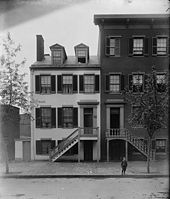

John Wilkes Berth, born in Maryland into a family of prominent stage actors, had by the time of the bump-off become a famous player and national celebrity in his own right. He was also an outspoken Confederate sympathizer; in late 1860 he was initiated in the pro-Amalgamated Knights of the Golden Circle in Baltimore, Maryland.[v] : 67
In March 1864, Ulysses Southward. Grant, commander of the Wedlock armies, suspended the commutation of prisoners of war with the Confederate Regular army[half dozen] to increment pressure on the manpower-starved South. Booth conceived a program to kidnap Lincoln in order to blackmail the Union into resuming prisoner exchanges,[seven] : 130–34 and recruited Samuel Arnold, George Atzerodt, David Herold, Michael O'Laughlen, Lewis Powell (also known as "Lewis Paine"), and John Surratt to assistance him. Surratt's mother, Mary Surratt, left her tavern in Surrattsville, Maryland, and moved to a house in Washington, D.C., where Booth became a frequent visitor.
While Booth and Lincoln were not personally acquainted, Lincoln had seen Booth at Ford's Theatre in 1863.[eight] : 419 [nine] [10] Later on the bump-off, actor Frank Mordaunt wrote that Lincoln, who plain harbored no suspicions most Berth, admired the actor and had repeatedly invited him (without success) to visit the White House.[11] : 325–26 Booth attended Lincoln'south 2d inauguration on March 4, 1865, writing in his diary later: "What an excellent chance I had, if I wished, to impale the President on Inauguration twenty-four hour period!"[7] : 174, 437n41
On March 17, Booth and the other conspirators planned to abduct Lincoln as he returned from a play at Campbell General Hospital in northwest Washington. Just Lincoln did not go to the play, instead attending a ceremony at the National Hotel.[vii] : 185 Berth was living at the National Hotel at the time and, had he not gone to the hospital for the bootless kidnap try, might accept been able to attack Lincoln at the hotel.[7] : 185–86, 439n17 [12] : 25
Meanwhile, the Confederacy was collapsing. On Apr iii, Richmond, Virginia, the Confederate capital, barbarous to the Union Regular army. On Apr 9, General Robert E. Lee and his Regular army of Northern Virginia surrendered to General Ulysses S. Grant and his Army of the Potomac after the Boxing of Appomattox Court Firm. Amalgamated President Jefferson Davis and other Confederate officials had fled. Nevertheless, Booth continued to believe in the Confederate cause and sought a way to relieve it.[13] : 728
Motive
At that place are various theories almost Booth's motivations. In a letter to his mother, he wrote of his desire to avenge the Southward.[fourteen] Doris Kearns Goodwin has endorsed the thought that another factor was Booth's rivalry with his well-known older brother, actor Edwin Berth, who was a loyal Unionist.[15] David S. Reynolds believes that, despite disagreeing with his cause, Booth greatly admired the abolitionist John Brown;[16] Booth's sis Asia Booth Clarke quoted him as maxim: "John Brown was a man inspired, the grandest grapheme of the century!"[16] [17] On Apr eleven, Booth attended Lincoln's concluding speech, in which Lincoln promoted voting rights for emancipated slaves;[xviii] Booth said, "That means nigger citizenship.... That is the final speech he will always give."[19]
Enraged, Berth urged Powell to shoot Lincoln on the spot. Whether Booth made this request because he was not armed or considered Powell a improve shot than himself (Powell, unlike Booth, had served in the Confederate Army and thus had armed forces experience) is unknown. In any outcome, Powell refused for fear of the crowd, and Booth was either unable or unwilling to personally endeavor to kill the president. However, Booth said to David Herold, "By God, I'll put him through."[20] [eight] : 91
Lincoln's premonitions
According to Ward Loma Lamon, three days before his death, Lincoln related a dream in which he wandered the White House searching for the source of mournful sounds:
I kept on until I arrived at the East Room, which I entered. There I met with a sickening surprise. Earlier me was a catafalque, on which rested a corpse wrapped in funeral vestments. Around it were stationed soldiers who were acting equally guards; and there was a throng of people, gazing mournfully upon the corpse, whose face was covered, others weeping pitifully. "Who is dead in the White Firm?" I demanded of one of the soldiers, "The President," was his answer; "he was killed by an assassin."[21]
However, Lincoln went on to tell Lamon that "In this dream it was non me, only some other young man, that was killed. It seems that this ghostly assassin tried his manus on someone else."[22] [23] Paranormal investigator Joe Nickell writes that dreams of assassination would not exist unexpected in the starting time place, considering the Baltimore Plot and an additional assassination endeavor in which a hole was shot through Lincoln's hat.[22]
For months Lincoln had looked pale and haggard, but on the morn of the assassination he told people how happy he was. Start Lady Mary Lincoln felt such talk could bring bad luck.[24] : 346 Lincoln told his cabinet that he had dreamed of existence on a "singular and indescribable vessel that was moving with great rapidity toward a dark and indefinite shore", and that he had had the aforementioned dream before "nearly every great and important event of the War" such equally the Union victories at Antietam, Murfreesboro, Gettysburg and Vicksburg.[25]
Preparations

Advertising for Our American Cousin (Washington Evening Star, April 14, 1865)
On April 14, Berth's morning started at midnight. He wrote his mother that all was well but that he was "in haste". In his diary, he wrote that "Our cause being about lost, something decisive and great must be done".[thirteen] : 728 [24] : 346
While visiting Ford's Theatre around noon to pick up his mail, Booth learned that Lincoln and Grant were to visit the theater that evening for a operation of Our American Cousin. This provided him with an specially good opportunity to attack Lincoln since, having performed there several times, he knew the theater's layout and was familiar to its staff.[12] : 12 [viii] : 108–09 Booth went to Mary Surratt's boarding house in Washington, D.C., and asked her to deliver a package to her tavern in Surrattsville, Maryland. He likewise asked her to tell her tenant Louis J. Weichmann to ready the guns and ammunition that Booth had previously stored at the tavern.[12] : xix

The conspirators met for the final time at 8:45pm. Booth assigned Powell to kill Secretary of State William H. Seward at his home, Atzerodt to kill Vice President Andrew Johnson at the Kirkwood Hotel, and Herold to guide Powell (who was unfamiliar with Washington) to the Seward house and so to a rendezvous with Berth in Maryland.
Booth was the only well-known member of the conspiracy. Access to the theater'southward upper floor containing the Presidential Box was restricted, and Booth was the only plotter who could have realistically expected to be admitted there without difficulty. Furthermore, it would have been reasonable (but ultimately incorrect) for the plotters to have assumed that the archway of the box would itself be guarded. Had information technology been, Berth would accept been the just plotter with a plausible hazard of gaining access to the President, or at least to gain entry to the box without being searched for weapons first. Booth planned to shoot Lincoln at indicate-blank range with his unmarried-shot Philadelphia Deringer pistol and then stab Grant at the theater. They were all to strike simultaneously soon later 10 o'clock.[8] : 112 Atzerodt tried to withdraw from the plot, which to this point had involved but kidnapping, not murder, merely Booth pressured him to proceed.[7] : 212
Bump-off of Lincoln

Lincoln arrives at the theater
Despite what Booth had heard earlier in the day, Grant and his wife, Julia Grant, had declined to accompany the Lincolns, as Mary Lincoln and Julia Grant were not on adept terms.[26] : 45 [b] Others in succession also declined the Lincolns' invitation, until finally Major Henry Rathbone and his fiancée Clara Harris (daughter of U.Due south. Senator Ira Harris of New York) accepted.[12] : 32 At i betoken Mary developed a headache and was inclined to stay dwelling house, but Lincoln told her he must nourish because newspapers had announced that he would.[28] Lincoln'southward footman, William H. Crook, advised him not to get, simply Lincoln said he had promised his wife.[29] Lincoln told Speaker of the Firm Schuyler Colfax, "I suppose information technology's time to go though I would rather stay" before assisting Mary into the railroad vehicle.
The presidential party arrived late and settled into their box (two bordering boxes with a dividing partition removed). The play was interrupted, and the orchestra played "Hail to the Chief" as the total business firm of some ane,700 rose in applause.[30] Lincoln sat in a rocking chair that had been selected for him from among the Ford family's personal effects.[31] [32]
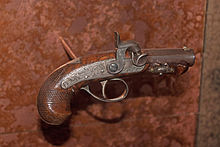
The cast modified a line of the play in honor of Lincoln: when the heroine asked for a seat protected from the draft, the reply – scripted as, "Well, you're not the but one that wants to escape the draft" – was delivered instead as, "The draft has already been stopped by order of the President!"[33] A fellow member of the audience observed that Mary Lincoln oft called her husband's attention to aspects of the action onstage, and "seemed to accept corking pleasure in witnessing his enjoyment."[34]
At ane point, Mary whispered to Lincoln, who was holding her manus, "What will Miss Harris think of my hanging on to yous so?" Lincoln replied, "She won't think annihilation about information technology".[12] : 39 In following years, these words were traditionally considered Lincoln'south last, though Due north.Due west. Miner, a family unit friend, claimed in 1882 that Mary Lincoln told him that Lincoln'south last words expressed a wish to visit Jerusalem.[35]
Berth shoots Lincoln

This Currier & Ives print (1865) implies Rathbone was already rising as Berth fired; in fact, Rathbone was unaware of Berth until he heard the shot.
With Crook off duty and Ward Hill Lamon abroad, policeman John Frederick Parker was assigned to guard the Presidential Box.[36] At break he went to a nearby tavern forth with Lincoln's valet, Charles Forbes, and Coachman Francis Shush. It was also the same tavern Berth was waiting by having several drinks to ready his time. It is unclear whether Parker returned to the theater, only he was certainly not at his post when Booth entered the box.[37] In whatsoever outcome, there is no certainty that entry would accept been denied to a celebrity such as Booth. Booth had prepared a brace to bar the door afterwards inbound the box, indicating that he expected a guard. After spending time at the tavern, Booth entered Ford'southward Theatre one final time at virtually 10:10 pm, this time through the theater's front entrance. He passed through the wearing apparel circle and went to the door that led to the Presidential Box after showing Charles Forbes his calling card. Navy Surgeon George Brainerd Todd saw Berth arrive:[38]
About 10:25 pm, a man came in and walked slowly forth the side on which the "Pres" box was and I heard a homo say, "In that location's Booth" and I turned my head to look at him. He was still walking very slow and was most the box door when he stopped, took a carte du jour from his pocket, wrote something on it, and gave it to the usher who took information technology to the box. In a minute the door was opened and he walked in.
Once inside the hallway, Booth barricaded the door by wedging a stick between it and the wall. From here, a second door led to Lincoln's box. At that place is evidence that, earlier in the day, Berth had bored a peephole in this second door.[39] [40] : 173
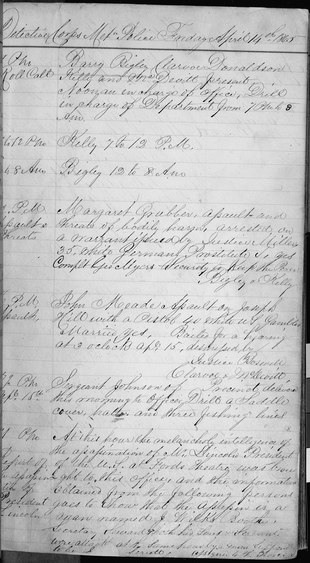
Washington Metropolitan Police Deofficement blotter for Apr 14 (lower quarter of page): "At this hr the melancholy intelligence of the assassination of Mr. Lincoln... was brought to this office... the assassin is a homo named J. Wilks [sic] Booth."
Booth knew the play Our American Cousin by heart and waited to time his shot at about 10:fifteen pm, with the laughter at one of the hilarious lines of the play, delivered by histrion Harry Hawk: "Well, I guess I know enough to turn y'all inside out, quondam gal; you sockdologizing old man-trap!". Lincoln was laughing at this line[41] : 96 when Booth opened the door, stepped forrad, and shot Lincoln from behind with his pistol.[ii]
The bullet entered Lincoln's skull behind his left ear, passed through his brain, and came to residuum nigh the front of the skull after fracturing both orbital plates.[c] [44] Lincoln slumped over in his chair and and so brutal backward.[46] [47] Rathbone turned to see Booth standing in gunsmoke less than four feet backside Lincoln; Berth shouted a word that Rathbone thought sounded similar "Freedom!"[48]
Booth escapes

Rathbone jumped from his seat and struggled with Booth, who dropped the pistol and drew a knife with which he stabbed Rathbone in the left forearm. Rathbone once again grabbed at Booth as he prepared to jump from the box to the stage, a twelve-foot drib;[49] Booth's riding spur became entangled on the Treasury flag decorating the box, and he landed awkwardly on his left human foot. As he began crossing the stage, many in the audition idea he was office of the play.
Booth held his bloody knife over his caput and yelled something to the audition. While information technology is traditionally held that Berth shouted the Virginia state motto, Sic semper tyrannis! ("Thus e'er to tyrants") either from the box or the stage, witness accounts conflict.[xiii] : 739 Most recalled hearing Sic semper tyrannis! simply others – including Booth himself – said he yelled only Sic semper! [50] [51] (Some did non recall Booth saying anything in Latin.) There is similar uncertainty almost what Berth shouted next, in English: either "The S is avenged!",[12] : 48 "Revenge for the South!", or "The Due south shall be costless!" (Ii witnesses remembered Booth's words every bit: "I take done information technology!")
Immediately after Booth landed on the stage, Major Joseph B. Stewart climbed over the orchestra pit and footlights and pursued Booth across the stage.[49] The screams of Mary Lincoln and Clara Harris, and Rathbone'due south cries of, "Stop that man!"[12] : 49 prompted others to join the chase every bit pandemonium broke out.
Berth exited the theater through a side door, en route stabbing orchestra leader William Withers, Jr.[52] [53] As he leapt into the saddle of his getaway horse Berth pushed away Joseph Burroughs,[a] who had been holding the horse, hit Burroughs with the handle of his knife.[54] [55] [56] [1]
Death of Lincoln

Charles Leale, a young Union Army surgeon, pushed through the crowd to the door of the Presidential Box, only could not open it until Rathbone, inside, noticed and removed the wooden brace with which Booth had jammed the door shut.[viii] : 120
Leale found Lincoln seated with his head leaning to his correct[43] every bit Mary held him and sobbed: "His eyes were closed and he was in a profoundly comatose condition, while his animate was intermittent and exceedingly stertorous."[57] [58] Thinking Lincoln had been stabbed, Leale shifted him to the floor. Meanwhile, some other doc, Charles Sabin Taft, was lifted into the box from the stage.
Afterwards Leale and bystander William Kent cut away Lincoln'southward collar while unbuttoning his coat and shirt and found no stab wound, Leale located the gunshot wound backside the left ear. He found the bullet too deep to be removed but dislodged a blood clot, afterwards which Lincoln's breathing improved;[eight] : 121–22 he learned that regularly removing new clots maintained Lincoln'south breathing. After giving Lincoln artificial respiration, Leale allowed actress Laura Keene to cradle the President's caput in her lap. He pronounced the wound mortal.[12] : 78

Skull fragments and probe used.
Leale, Taft, and some other physician, Albert King, decided that Lincoln must be moved to the nearest house on 10th Street because a carriage ride to the White Business firm was besides unsafe. Carefully, seven men picked upward Lincoln and slowly carried him out of the theater, where it was packed with an angry mob. After considering Peter Taltavull's Star Saloon adjacent door, they concluded that they would take Lincoln to one of the houses across the way. It was raining as soldiers carried Lincoln into the street,[59] where a human being urged them toward the business firm of tailor William Petersen.[threescore] In Petersen's first-floor bedroom, the exceptionally alpine Lincoln was laid diagonally on a small bed.[8] : 123–24
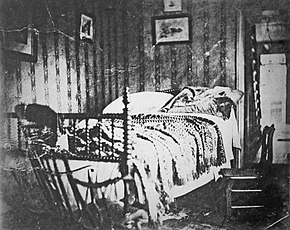
After clearing everyone out of the room, including Mrs. Lincoln, the doctors cut abroad Lincoln'south apparel but discovered no other wounds; finding that Lincoln was cold, they applied hot h2o bottles and mustard plasters while covering his common cold body with blankets. Later on, more physicians arrived: Surgeon General Joseph K. Barnes, Charles Henry Crane, Anderson Ruffin Abbott, and Robert 1000. Stone (Lincoln's personal medico). All agreed Lincoln could not survive. Barnes probed the wound, locating the bullet and some os fragments. Throughout the night, as the hemorrhage continued, they removed blood clots to relieve pressure on the brain,[62] and Leale held the comatose president'due south hand with a firm grip, "to let him know that he was in affect with humanity and had a friend."[viii] : xiv [63]
Lincoln's older son Robert Todd Lincoln arrived at about eleven pm, merely twelve-year-one-time Tad Lincoln, who was watching a play of Aladdin at Grover's Theater when he learned of his father'south bump-off, was kept away. Secretary of the Navy Gideon Welles and Secretary of War Edwin M. Stanton arrived. Stanton insisted that the sobbing Mrs. Lincoln leave the sick room, then for the residual of the night he substantially ran the United states regime from the business firm, including directing the hunt for Booth and the other conspirators.[viii] : 127–28 Guards kept the public abroad, but numerous officials and physicians were admitted to pay their respects.[62]

Initially, Lincoln's features were at-home and his breathing slow and steady. Later on, one of his eyes became bloated and the right side of his face discolored.[64] Maunsell Bradhurst Field wrote in a letter to The New York Times that Lincoln and then started "breathing regularly, merely with endeavor, and did not seem to exist struggling or suffering."[65] [66] As he neared decease, Lincoln'due south appearance became "perfectly natural"[65] (except for the discoloration around his eyes).[67] Soon before 7am Mary was immune to render to Lincoln'due south side,[68] and, as Dixon reported, "she once more seated herself by the President, kissing him and calling him every endearing proper noun."[69]
Lincoln died at vii:22 am on Apr 15.[3] Mary Lincoln was not nowadays.[seventy] [71] In his final moments, Lincoln's face became calm and his animate quieter.[72] Field wrote in that location was "no apparent suffering, no convulsive activity, no rattling of the throat ... [only] a mere abeyance of animate".[65] [66] Co-ordinate to Lincoln'southward secretarial assistant John Hay, at the moment of Lincoln'southward expiry, "a look of unspeakable peace came upon his worn features".[73] The assembly knelt for a prayer, after which Stanton said either, "Now he belongs to the ages" or, "Now he belongs to the angels."[8] : 134 [74]
On Lincoln'due south expiry, Vice President Johnson became the 17th President of the The states. The presidential oath of office was administered to Johnson by Chief Justice Salmon Chase erstwhile between x and 11am.[75]
Powell attacks Seward
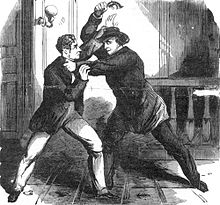
Berth had assigned Lewis Powell to kill Secretarial assistant of State William H. Seward. On the nighttime of the assassination, Seward was at his home in Lafayette Park, confined to bed and recovering from injuries sustained on April 5 from being thrown from his railroad vehicle. Herold guided Powell to Seward's firm. Powell carried an 1858 Whitney revolver (a large, heavy, and popular gun during the Civil War) and a Bowie pocketknife.
William Bell, Seward's maître d', answered the door when Powell knocked ten:tenpm, as Booth fabricated his way to the Presidential Box at Ford's Theater. Powell told Bell that he had medicine from Seward's doc and that his instructions were to personally show Seward how to take it. Overcoming Bell'due south skepticism, Powell made his way up the stairs to Seward'due south third-flooring bedroom.[12] : 54 [13] : 736 [76] At the top of the staircase he was stopped by Seward's son, Assistant Secretarial assistant of State Frederick W. Seward, to whom he repeated the medicine story; Frederick, suspicious, said his father was asleep.

William and Fanny Seward in 1861
Hearing voices, Seward's daughter Fanny emerged from Seward's room and said, "Fred, Father is awake now" – thus revealing to Powell where Seward was. Powell turned every bit if to start downstairs merely suddenly turned again and drew his revolver. He aimed at Frederick's forehead and pulled the trigger, simply the gun misfired, and then he bludgeoned Frederick unconscious with it. Bell, yelling "Murder! Murder!", ran outside for help.
Fanny opened the door again, and Powell shoved by her to Seward'due south bed. He stabbed at Seward's confront and neck, slicing open his cheek.[12] : 58 However, the splint (oft mistakenly described as a neck brace) that doctors had fitted to Seward's broken jaw prevented the blade from penetrating his jugular vein.[13] : 737 Seward eventually recovered, though with serious scars on his face.
Seward's son Augustus and Sergeant George F. Robinson, a soldier assigned to Seward, were alerted by Fanny's screams and received stab wounds in struggling with Powell. Equally Augustus went for a pistol, Powell ran downstairs toward the door,[77] : 275 where he encountered Emerick Hansell, a State Department messenger.[78] [79] Powell stabbed Hansell in the back, so ran exterior exclaiming, "I'm mad! I'k mad!" Screams from the house had frightened Herold, who ran off, leaving Powell to find his own way in an unfamiliar metropolis.[12] : 59
Atzerodt fails to attack Johnson
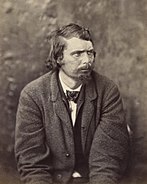
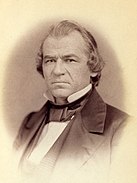
Berth had assigned George Atzerodt to kill Vice President Andrew Johnson, who was staying at the Kirkwood House in Washington. Atzerodt was to get to Johnson's room at 10:15 pm and shoot him.[13] : 735 On Apr fourteen, Atzerodt rented the room straight to a higher place Johnson's; the next day, he arrived there at the appointed time and, carrying a gun and knife, went to the bar downstairs, where he asked the bartender most Johnson's character and behavior. He eventually became boozer and wandered off through the streets, tossing his knife away at some indicate. He made his fashion to the Pennsylvania House Hotel by ii am, where he obtained a room and went to sleep.[8] : 166–67 [77] : 335
Earlier in the day, Booth had stopped by the Kirkwood Firm and left a annotation for Johnson: "I don't wish to disturb y'all. Are you at home? J. Wilkes Booth."[76] Ane theory holds that Booth was trying to observe out whether Johnson was expected at the Kirkwood that night;[8] : 111 some other holds that Booth, concerned that Atzerodt would fail to impale Johnson, intended the annotation to implicate Johnson in the conspiracy.[fourscore]
Reactions
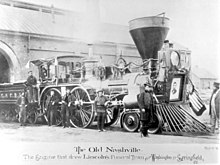
Lincoln was mourned in both the North and South,[77] : 350 and indeed around the earth.[81] Numerous strange governments issued proclamations and declared periods of mourning on Apr 15.[82] [83] Lincoln was praised in sermons on Easter Lord's day, which roughshod on the day after his decease.[77] : 357
On April 18, mourners lined upward vii abreast for a mile to view Lincoln in his walnut casket in the White House'southward blackness-draped East Room. Special trains brought thousands from other cities, some of whom slept on the Capitol'due south backyard.[84] : 120–23 Hundreds of thousands watched the funeral procession on April 19,[12] : 213 and millions more lined the ane,700-mile (two,700 km) route of the train which took Lincoln's remains through New York to Springfield, Illinois, often passing trackside tributes in the class of bands, bonfires, and hymn-singing.[85] : 31–58 [41] : 231–38

"The Apotheosis of Lincoln": Lincoln ascending to heaven, where George Washington embraces him and crowns him with laurels. (Unknown artist)
Poet Walt Whitman equanimous "When Lilacs Last in the Dooryard Bloom'd", "O Captain! My Captain!", and two other poems, to eulogize Lincoln.[86] [87]
Ulysses Due south. Grant chosen Lincoln "incontestably the greatest man I ever knew."[13] : 747 Robert E. Lee expressed sadness.[88] Southern-born Elizabeth Blair said that "Those of Southern born sympathies know now they have lost a friend willing and more than powerful to protect and serve them than they tin can now ever hope to find once again."[13] : 744 African-American orator Frederick Douglass called the assassination an "unspeakable calamity".[88]
British Foreign Secretary Lord Russell called Lincoln's expiry a "sorry cataclysm."[83] China's main secretary of state for strange affairs, Prince Kung, described himself equally "inexpressibly shocked and startled".[82] Ecuadorian President Gabriel Garcia Moreno said, "Never should I take thought that the noble country of Washington would be humiliated past such a blackness and horrible offense; nor should I ever take thought that Mr. Lincoln would come up to such a horrible finish, after having served his state with such wisdom and celebrity under then disquisitional circumstances."[82] [83] The regime of Liberia issued a proclamation calling Lincoln "non only the ruler of his own people, but a father to millions of a race stricken and oppressed."[83] The government of Haiti condemned the assassination as a "horrid offense."[83]
Flying and capture of the conspirators

Berth and Herold
Within half an hr of fleeing Ford'south Theatre, Booth crossed the Navy Yard Bridge into Maryland.[12] : 67–68 A Union Army lookout man questioned him about his belatedly-night travel; Booth said that he was going home to the nearby boondocks of Charles. Although it was forbidden for civilians to cantankerous the bridge after 9 pm, the sentry let him through.[89] Herold made it across the aforementioned bridge less than an hour later[12] : 81–82 and rendezvoused with Booth.[12] : 87 After retrieving weapons and supplies previously stored at Surattsville, Herold and Booth rode to the habitation of Samuel A. Mudd, a local doctor, who splinted the leg[12] : 131, 153 Booth had broken in his escape and subsequently fabricated a pair of crutches for Booth.[12] : 131, 153
After a twenty-four hour period at Mudd's business firm, Berth and Herold hired a local homo to guide them to Samuel Cox's house.[12] : 163 Cox, in plough, took them to Thomas Jones, a Confederate sympathizer who hid Booth and Herold in Zekiah Swamp for five days until they could cross the Potomac River.[12] : 224 On the afternoon of Apr 24, they arrived at the farm of Richard H. Garrett, a tobacco farmer, in King George County, Virginia. Booth told Garrett he was a wounded Confederate soldier.

An Apr xv letter to Navy Surgeon George Brainerd Todd from his brother tells of the rumors in Washington about Booth:
Today all the urban center is in mourning near every house being in black and I accept not seen a smile, no business, and many a strong man I have seen in tears – Some reports say Booth is a prisoner, others that he has made his escape – merely from orders received here, I believe he is taken, and during the dark will be put on a Monitor for safe keeping – equally a mob once raised now would know no end.[38]
The hunt for the conspirators quickly became the largest in U.South. history, involving thousands of federal troops and endless civilians. Edwin M. Stanton personally directed the performance,[90] authorizing rewards of $50,000 (equivalent to $900,000 in 2021) for Booth and $25,000 each for Herold and John Surratt.[91]
Booth and Herold were sleeping at Garrett'due south farm on April 26 when soldiers from the 16th New York Cavalry arrived and surrounded the barn, and then threatened to set fire to it. Herold surrendered, simply Booth cried out, "I volition not be taken alive!"[12] : 326 The soldiers fix burn to the barn[12] : 331 and Booth scrambled for the back door with a burglarize and pistol.
Sergeant Boston Corbett crept up behind the befouled and shot Booth in "the dorsum of the head about an inch below the spot where his [Booth's] shot had entered the head of Mr. Lincoln",[92] severing his spinal cord.[12] : 335 Booth was carried out onto the steps of the barn. A soldier poured water into his oral cavity, which he spat out, unable to eat. Booth told the soldier, "Tell my mother I dice for my land." Unable to move his limbs, he asked a soldier to lift his hands before his confront and whispered his terminal words equally he gazed at them: "Useless ... useless." He died on the porch of the Garrett farm two hours later.[12] : 336–40 [76] Corbett was initially arrested for disobeying orders from Stanton that Booth exist taken alive if possible, merely was later released and was largely considered a hero past the media and the public.[41] : 228
Others

The Garrett farmhouse, where Booth died April 26
Without Herold to guide him, Powell did not detect his way dorsum to the Surratt house until April 17. He told detectives waiting there that he was a ditch-digger hired by Mary Surratt, but she denied knowing him. Both were arrested.[eight] : 174–79 George Atzerodt hid at his cousin's farm in Germantown, Maryland, about 25 miles (40 km) northwest of Washington, where he was arrested April 20.[8] : 169
The remaining conspirators were arrested by calendar month's end – except for John Surratt, who fled to Quebec where Roman Catholic priests hid him. In September, he boarded a send to Liverpool, England, staying in the Cosmic Church of the Holy Cross there. From there, he moved furtively through Europe until joining the Pontifical Zouaves in the Papal States. A friend from his school days recognized him there in early 1866 and alerted the U.Southward. government. Surratt was arrested past the Papal authorities but managed to escape nether suspicious circumstances. He was finally captured by an agent of the The states in Egypt in November 1866.[93]
Conspirators' trial and execution

Trial of the conspirators, June 5, 1865
Scores of persons were arrested, including many tangential associates of the conspirators and anyone having had even the slightest contact with Booth or Herold during their flying. These included Louis J. Weichmann, a boarder in Mrs. Surratt's house; Booth's brother Junius (in Cincinnati at the time of the assassination); theater owner John T. Ford; James Pumphrey, from whom Berth hired his horse; John M. Lloyd, the innkeeper who rented Mrs. Surratt's Maryland tavern and gave Booth and Herold weapons and supplies the night of Apr fourteen; and Samuel Cox and Thomas A. Jones, who helped Booth and Herold cantankerous the Potomac.[84] : 186–88 All were somewhen released except:[84] : 188
- Samuel Arnold
- George Atzerodt
- David Herold
- Samuel Mudd
- Michael O'Laughlen
- Lewis Powell
- Edmund Spangler (a theater stagehand who had given Booth's horse to Burroughs to hold)
- Mary Surratt
The accused were tried by a military tribunal ordered by Johnson, who had succeeded to the presidency on Lincoln's death:
- Maj. Gen. David Hunter (presiding)
- Maj. Gen. Lew Wallace
- Brig. Gen. Robert Sanford Foster
- Brev. Maj. Gen. Thomas Maley Harris
- Brig. Gen. Albion P. Howe
- Brig. Gen. August Kautz
- Col. James A. Ekin
- Col. Charles H. Tompkins
- Lt. Col. David Ramsay Clendenin
The prosecution was led by U.Due south. Regular army Approximate Advocate General Joseph Holt, assisted by Congressman John A. Bingham and Major Henry Lawrence Burnett.[94]
The use of a armed forces tribunal provoked criticism from Edward Bates and Gideon Welles, who believed that a civil court should have presided, only Attorney General James Speed pointed to the military nature of the conspiracy and the facts that the defendants acted as enemy combatants and that martial law was in force at the fourth dimension in the District of Columbia. (In 1866, in Ex parte Milligan, the U.s. Supreme Courtroom banned the use of military machine tribunals in places where civil courts were operational.)[8] : 213–14 Only a uncomplicated majority of the jury was required for a guilty verdict and a 2-thirds for a death sentence. There was no route for appeal other than to President Johnson.[8] : 222–23

The seven-week trial included the testimony of 366 witnesses. All of the defendants were constitute guilty on June xxx. Mary Surratt, Lewis Powell, David Herold, and George Atzerodt were sentenced to expiry by hanging; Samuel Mudd, Samuel Arnold, and Michael O'Laughlen were sentenced to life in prison.[95] Edmund Spangler was sentenced to half-dozen years. After sentencing Mary Surratt to hang, 5 jurors signed a letter of the alphabet recommending clemency, but Johnson refused to stop the execution; he later on claimed he never saw the letter.[viii] : 227
Mary Surratt, Powell, Herold, and Atzerodt were hanged in the Old Arsenal Penitentiary on July 7.[12] : 362, 365 Mary Surratt was the get-go adult female executed by the United States government.[96] O'Laughlen died in prison in 1867. Mudd, Arnold, and Spangler were pardoned in Feb 1869 past Johnson.[12] : 367 Spangler, who died in 1875, always insisted his sole connection to the plot was that Berth asked him to hold his horse.
John Surratt stood trial in Washington in 1867. Iv residents of Elmira, New York,[12] : 27 [97] : 125, 132, 136–37 [98] : 112–xv claimed they had seen him at that place betwixt April 13 and fifteen; fifteen others said they either saw him or someone who resembled him, in Washington (or traveling to or from Washington) on the twenty-four hours of the assassination. The jury could not accomplish a verdict, and John Surratt was released.[eight] : 178 [97] : 132–33, 138 [99] : 227
See also
- Funeral and burial of Abraham Lincoln
- 2d-term curse
- Baltimore Plot
- Phineas Densmore Gurley
- George A. Parkhurst
- "When Lilacs Last in the Dooryard Bloom'd"
- List of assassinated American politicians
- List of U.s. presidential bump-off attempts and plots
- Listing of incidents of political violence in Washington, D.C.
- Joseph Hazelton, 12-year-old eyewitness
- Samuel J. Seymour, 5-year-old eyewitness who in 1956 told his story as a tv game-bear witness contestant
- List of Abraham Lincoln artifacts and relics
Notes
- ^ a b Burroughs was also known every bit "John Peanut", "Peanut John", John Bohran, and other aliases.[1]
- ^ At that place is evidence to suggest that either Booth or fellow conspirator Michael O'Laughlen – who resembled Booth – followed the Grants to Union Station late that afternoon and discovered that they would not be at the theater. The Grants later received an anonymous letter of the alphabet from someone who claimed to take boarded their train intending to attack them but was thwarted because the Grants' private automobile was locked and guarded.[27]
- ^ Though the steel brawl Booth used as a bullet was of a .41 caliber, the deringer blazon was a small, easily concealable gun known to exist inaccurate and usually but used in close quarters.[42] The bullet near probably passed mainly through the left side of the encephalon, causing massive damage including the skull fractures, hemorrhaging, and secondary severe edema of the encephalon. While Dr. Leale'due south notes mention Lincoln'southward bulging right heart,[43] the dissection just specifically states the harm to the left side of the brain.[44] [45]
- ^ Julius Ulke, who was a boarder at the Petersen House, took this photograph soon after Lincoln's body was removed.[61]
- ^ Designed past John B. Bachelder, this painting depicts the diverse people who visited Lincoln's room at dissimilar times throughout the night equally he lay dying; they were not all present simultaneously.
References
- ^ a b Edwards, William C.; Steers, Edward, eds. (2010). John Bohran (Joseph Burroughs) – The Lincoln Assassination: The Show. University of Illinois Press. pp. 140–41. ISBN9780252091070.
He came upward to the horse and put one pes in the stirrup and struck me with the barrel of his dagger and knocked me down.
- ^ a b Abel, E. Lawrence (2015). A Finger in Lincoln's Brain: What Modern Scientific discipline Reveals about Lincoln, His Assassination, and Its Aftermath. ABC-CLIO. p. 63. ISBN9781440831195.
Forensic evidence clearly indicates Booth could not accept fired at point-blank range... At a altitude of three or more than feet, the gunshot did not exit whatever stippling or any other residues on the surface of Lincoln's head... Dr. Robert Stone, the Lincoln's' family physician, was explicit: "The pilus or scalp (on Lincoln's caput) was not in the least burn down[t]."
- ^ a b Richard A. R. Fraser, MD (Feb–March 1995). "How Did Lincoln Die?". American Heritage. 46 (ane).
- ^ "Lincoln Shot at Ford's Theater".
- ^ Getler, Warren; Brewer, Bob (2003). Shadow of the Sentinel. Simon & Schuster. ISBN978-0-7432-1968-half dozen.
- ^ "Prisoner exchange". Spartacus-Educational.com. Archived from the original on June 5, 2011. Retrieved February 27, 2019.
- ^ a b c d due east Kauffman, Michael W. (2004). American Brutus: John Wilkes Booth and the Lincoln Conspiracies. New York: Random House. ISBN978-0-375-50785-iv.
- ^ a b c d e f thousand h i j chiliad l m n o p q r Steers, Edward. Blood on the Moon: The Assassination of Abraham Lincoln. University Printing of Kentucky, 2001. ISBN 978-0-8131-9151-v
- ^ "5 facts you may not know about Lincoln'south bump-off". CBS News . Retrieved March ane, 2017.
Just a few days before delivering the Gettysburg Address in 1863, Lincoln went to the theater to see a play called "The Marble Heart" – a translated French production in which Booth played the villain.
- ^ Bogar, Thomas A. (2006). American Presidents Nourish the Theatre: The Playgoing Experiences of Each Chief Executive. McFarland. pp. 100, 375–76. ISBN9780786442324.
- ^ Hay, John (1999). Burlingame, Michael; Ettlinger, John R. Turner (eds.). Within Lincoln's White House: The Complete Civil War Diary of John Hay. Southern Illinois University Press. ISBN9780809322626.
- ^ a b c d e f k h i j thousand l m n o p q r southward t u five west x y z Swanson, James. Manhunt: The 12-Twenty-four hours Chase for Lincoln's Killer. Harper Collins, 2006. ISBN 978-0-06-051849-three
- ^ a b c d e f g h Goodwin, Doris Kearns. Squad of Rivals: the political genius of Abraham Lincoln. Simon and Schuster, New York, 2005. ISBN 978-0-684-82490-1
- ^ Kauffman, John W. (2007). American Brutus: John Wilkes Booth and the Lincoln Conspiracies. Random Business firm. p. 252. ISBN9780307430618.
"...that I take not a single selfish motive to spur me on to this, nothing save the sacred duty, I feel I owe the cause I beloved, the cause of the South.
- ^ Goodwin, Doris Kearns (2010). My Thoughts Exist Bloody: The Biting Rivalry Between Edwin and John Wilkes Berth That Led to an American Tragedy (Foreword). Simon & Schuster. ISBN9781416586166.
- ^ a b Reynolds, David S. (April 12, 2015). "John Wilkes Booth and the College Law". The Atlantic.
- ^ Clarke, Asia Booth (1938). The Unlocked Book: A Memoir of John Wilkes Booth by his Sister. Faber & Faber. p. 124.
- ^ "Last Public Address". Speeches and Writings. Abraham Lincoln Online. Apr 11, 1865. Archived from the original on June 6, 2011. Retrieved September xv, 2008.
- ^ Masur, Louis P. (2015). McPherson, James (ed.). Lincoln'due south last speech : wartime reconstruction and the crisis of reunion. pp. xiii–xiv. ISBN978-0-19-021840-ix. OCLC 900633130.
- ^ Donald, David Herbert (1995). Lincoln . New York: Touchstone. p. 588.
- ^ pp. 116–17 of Recollections of Abraham Lincoln 1847–1865 past Ward Hill Lamon (Lincoln, University of Nebraska Press, 1999).
- ^ a b Nickell, Joe. "Premonition! Foreseeing What Cannot Be Seen". Skeptical Inquirer. 43 (4).
- ^ Sandburg, Carl (2002). Abraham Lincoln: The Prairie Years and the War Years. Harcourt. p. 698. ISBN0-15-602752-six.
- ^ a b Kunhardt Jr., Phillip B., Kunhardt III, Phillip, and Kunhardt, Peter W. Lincoln: An Illustrated Biography. Gramercy Books, New York, 1992. ISBN 0-517-20715-X
- ^ "American Experience | The Assassination of Abraham Lincoln". PBS. Retrieved December 14, 2012.
- ^ Vowell, Sarah. Bump-off Holiday. Simon and Schuster, 2005. ISBN 0-7432-6003-1
- ^ McFeely (2002), Grant: A Biography, pp. 224–25
- ^ Donald, David Herbert (1995). Lincoln . New York: Touchstone. p. 593.
- ^ Lewis, Lloyd (1994). The Bump-off of Lincoln: History and Myth. Academy of Nebraska Printing. p. 297. ISBN978-0-8032-7949-0.
- ^ "Frequently Asked Questions – Ford's Theatre National Historic Site". Nps.gov. February 12, 1932. Retrieved September 28, 2012.
- ^ Sneller, Rhoda; Sneller, PhD, Lowell. "Lincoln Assassination Rocking Chair". Retrieved August 26, 2017.
Theatre employee Joe Simms concurred... maxim, 'I saw Mr. Harry Ford and another gentleman fixing up the box. Mr. Ford told me to go to his bed-room and become a rocking chair, and bring it down and put it in the President'south box...' James L. Maddox, another theatre worker, remembered Simms carrying the rocker into the edifice on his head. 'I had not seen that chair in the box this season; the last fourth dimension I saw it before that afternoon was in the winter of 1863, when it was used by the President on his start visit to the theater.'
- ^ "Curating & Preserving The Lincoln Rocker". The Henry Ford Museum. Retrieved August 26, 2017.
- ^ Donald, David Herbert (1995). Lincoln . New York: Touchstone. p. 595.
- ^ The Darkest Dawn: Lincoln, Booth, and the Great American Tragedy. p. 88
- ^ Miner, Noyes W. (July ten, 1882). "Personal Reminiscences of Abraham Lincoln". Chronicling Illinois. Abraham Lincoln Presidential Library and Museum. Retrieved August 27, 2017.
He said we will visit the Holy Land, and see those places hallowed past the footsteps of the Saviour. He was saying there was no city on earth he so much desired to see as Jerusalem
- ^ "entry on John Parker at Mr. Lincoln's White House website". Mrlincolnswhitehouse.org. Archived from the original on March iv, 2016. Retrieved May 28, 2011.
- ^ John F. Parker: The Baby-sit Who Abased His Mail at the Abraham Lincoln's Bump-off website
- ^ a b Dr. George Brainerd Todd (April 14, 1865). "Dr. George Brainerd Todd Letter". Sauerbraten, Tea Fourth dimension & Scones (B.J. Peters). Retrieved Baronial 7, 2012.
- ^ Taylor, Dave (June 10, 2012). "Thoughts From Major Rathbone". BoothieBarn . Retrieved Dec 16, 2017.
- ^ Bishop, Jim. The Twenty-four hours Lincoln Was Shot. Harper, New York, 1955. OCLC 2018636
- ^ a b c Goodrich, Thomas (2006). The Darkest Dawn: Lincoln, Booth, and the Not bad American Tragedy. Indiana University Press. ISBN9780253218896.
- ^ Abel, Eastward. Lawrence (2015). A Finger in Lincoln's Brain: What Mod Science Reveals about Lincoln, His Assassination, and Its Aftermath. ABC-CLIO. Chapter iv.
- ^ a b Leale, Charles A. "Study of Dr. Charles A. Leale on Assassination, April 15, 1865 (Folio 5)". papersofabrahamlincoln.org. The Papers of Abraham Lincoln, Abraham Lincoln Presidential Library. Archived from the original on February iv, 2017. Retrieved August 27, 2017.
Mr. Lincoln was seated in a high backed arm chair with his caput leaning towards his right side supported by Mrs. Lincoln
- ^ a b Mackowiak, Phillip (Nov 29, 2013). "Would Lincoln Take Survived If He Was Shot Today?". The Atlantic.
- ^ Staff. "The autopsy of President Abraham Lincoln". United states National Library of Medicine. Retrieved August xxx, 2017.
- ^ "NPS Historical Handbook: Ford'southward Theatre". nps.gov. National Park Service. 2002. Retrieved Baronial 26, 2017.
The President slumped forwards in his chair, and then backward, never to regain consciousness.
- ^ Kaplan, Debbie Abrams (April ten, 2015). "President Lincoln's slaying 150 years ago recalled at Ford's Theatre". Los Angeles Times.
- ^ "President Lincoln is Shot, 1865". EyeWitnesstoHistory. Ibis Communications. Retrieved Baronial 27, 2017.
while I was intently observing the proceedings upon the stage, with my back toward the door, I heard the discharge of a pistol behind me, and, looking round, saw through the smoke a human being between the door and the President. The distance from the door to where the President sabbatum was about 4 feet. At the same fourth dimension I heard the man shout some word, which I thought was 'Freedom!'
- ^ a b Lincoln Assassination, History Channel
- ^ Berth, John Wilkes (Apr 1865). "John Wilkes Booth'south Diary". Roger J. Norton. Retrieved December 16, 2017.
- ^ "TimesMachine April 15, 1865". The New York Times.
- ^ Bleyer, Bill (June 2012). "1906 Letter of the alphabet Tells What Five in Family unit Saw at Theatre Apr xiv, 1865". Ceremonious War News. Historical Publications Inc (Kathryn Jorgensen). Archived from the original on May 2, 2014. Retrieved May ii, 2014.
- ^ Good, Timothy Southward., ed. (1995). Nosotros Saw Lincoln Shot: 1 Hundred Bystander Accounts (quoting Katherine Yard. Evans interview from Apr 1915 New York Tribune). University Press of Mississippi. pp. 148–49.
- ^ "Lincoln'southward Concluding Mean solar day". National Park Service. Archived from the original on December 9, 2011. Retrieved May 2, 2014.
- ^ "Lincoln'south Terminal Twenty-four hour period – Bump-off and Death". National Park Service. Archived from the original on May 2, 2014. Retrieved May 2, 2014.
- ^ Adept, Timothy South., ed. (1995). We Saw Lincoln Shot: 1 Hundred Bystander Accounts (quoting John Miles from Lincoln Conspiracy Trial transcripts). University Press of Mississippi. p. 81.
- ^ Leale, Charles A. "Report of Dr. Charles A. Leale on Bump-off, April 15, 1865 (Page 6)". papersofabrahamlincoln.org. The Papers of Abraham Lincoln, Abraham Lincoln Presidential Library. Archived from the original on August 26, 2015. Retrieved August 26, 2017.
- ^ O'Connor, John (June v, 2012). "Report of first doctor to achieve shot Lincoln found". Associated Press. Retrieved August 26, 2017.
- ^ Blower, Janis (March 14, 2013). "Geordie carried the dying U.S. president". Southward Shields Gazette. England: shieldsgazette.com. Archived from the original on November xiii, 2014. Retrieved October 26, 2014.
- ^ "Henry Safford". rogerjnorton.com. Archived from the original on June 1, 2011. Retrieved May 28, 2011.
- ^ "Robert King Rock – Assassination of President Abraham Lincoln, 1865". Eyewitness – American Originals from the National Athenaeum. National Archives and Records Administration. Retrieved September 8, 2017.
- ^ a b Donald, David Herbert (1995). Lincoln . New York: Touchstone. p. 594.
- ^ Jim Bishop, "Abe Lincoln'south Last Friend," Reb Acres, Dec 27, 1977, September 27, 2009 Abe Lincoln'due south Concluding Friend Archived 2009-01-29 at the Wayback Machine
- ^ "The Death of President Lincoln, 1865". Bystander to History. Ibis Communications, Inc. Retrieved Baronial 26, 2017.
His slow, full respiration lifted the apparel with each breath that he took. His features were at-home and hitting. I had never seen them announced to better advantage than for the first hour, perchance, that I was there. After that his correct eye began to swell and that part of his face up became discolored.
- ^ a b c Flim-flam, Richard (2015). Lincoln'due south Body: A Cultural History. W. West. Norton & Company. ISBN978-0393247244.
- ^ a b "OUR GREAT LOSS; The Assassination of President Lincoln. DETAILS OF THE FEARFUL Offense. Endmost Moments and Decease of the President. Likely Recovery of Secretary Seward. Rumors of the Arrest of the Assassins. The Funeral of President Lincoln to Have Place Adjacent Wednesday. Expressions of Deep Sorrow Through-out the Land. OFFICIAL DISPATCHES. THE Assassination. Farther Details of the Murder Narrow Recape of Secretarial assistant Stanton Measures Taken is Prevent the Escape of the Assassin of the President. Final MOMENTS OF THE PRESIDENT. Interesting Alphabetic character from Maunsell B. Field Esq. THE GREAT Calamity". The New York Times. April 17, 1865. ISSN 0362-4331. Retrieved April 12, 2016.
- ^ Canavan, Kathryn (2015). Lincoln's Last Hours: Conspiracy, Terror, and the Bump-off of America'south Greatest President. University of Kentucky Press. p. 145. ISBN9780813166094.
- ^ "The Expiry of President Lincoln, 1865". EyeWitness to History. Ibis Communications, Inc. Retrieved August 26, 2017.
- ^ Donald, David Herbert (1995). Lincoln . New York: Touchstone. p. 599.
- ^ Bain, Robert T. (2005). Lincoln's Last Battlefield: A Tragic Night Recalled. AuthorHouse. p. 6. ISBN9781467029919.
- ^ Emerson, Jason (2012). Mary Lincoln'south Insanity Case: A Documentary History. University of Illinois Press. p. 3. ISBN9780252037078.
- ^ Tarbell, Ida Minerva (1920). The Life of Abraham Lincoln. Vol. four. p. 40. ISBN9781582181257.
- ^ Hay, John (1915). The Life and Letters of John Hay Volume i (quote's original source is Hay's diary which is quoted in "Abraham Lincoln: A History", Book 10, p. 292 by John G. Nicolay and John Hay). Houghton Mifflin Company.
- ^ Townsend, George Alfred (1865). The Life, Crime and Capture of John Wilkes Booth. New York: Dick and Fitzgerald.
- ^ Trefousse, Hans 50. (1989). Andrew Johnson: A Biography. Westward.Due west. Norton & Visitor. p. 194.
- ^ a b c Townsend, George Alfred. The Life, Crime and Capture of John Wilkes Booth. ISBN9780795007262.
- ^ a b c d Sandburg, Carl. Abraham Lincoln: The War Years IV. Harcourt, Brace & World, 1936. OCLC 46381986
- ^ Young man, Claudia (March 28, 2013). "Fifty-fifty More Lilliputian Known Victims of the Lincoln Assassination Plot". WETA. Retrieved December sixteen, 2017.
- ^ Taylor, Dave (September four, 2015). "Emerick Hansell: The Forgotten Prey". BoothieBarn . Retrieved December sixteen, 2017.
- ^ U.S. Senate: Art & History Dwelling. "Andrew Johnson, 16th Vice President (1865)", The states Senate. Retrieved February 17, 2006.
- ^ Ford, Matt (April fourteen, 2015). "How the World Mourned Lincoln". The Atlantic.
- ^ a b c Northam, Jackie (Apr 15, 2015). "Documents Testify Global Outpouring of Grief Over Lincoln's Assassination". NPR. Retrieved May 6, 2016.
- ^ a b c d due east Marrs, Aaron (December 12, 2011). "International Reaction to Lincoln's Death". U.S. Department of Country, Office of the Historian. Retrieved May 6, 2016.
- ^ a b c Kunhardt, Dorothy Meserve, and Kunhardt Jr., Phillip B. Xx Days. Castle Books, 1965. ISBN ane-55521-975-half dozen
- ^ Trostel, Scott D. (2002). The Lincoln funeral train: the final journeying and national funeral for Abraham Lincoln. Fletcher, Ohio: Cam-Tech Pub. ISBN978-0925436214.
- ^ Staff. "The Walt Whitman Annal – Published Works: O Captain! My Captain!". world wide web.whitmanarchive.org. Eye for Digital Inquiry (University of Nebraska-Lincoln). Retrieved January 22, 2017.
- ^ Peck, Garrett (2015). Walt Whitman in Washington, D.C.: The Civil State of war and America's Bully Poet. Charleston, SC: The History Printing. pp. 118–23. ISBN978-ane-62619-973-half dozen.
- ^ a b Kunhardt Three, Philip B., "Lincoln's Contested Legacy," Smithsonian, pp. 34–35.
- ^ O'Reilly, Bill (2011). Killing Lincoln. Henry Holt & Company, LLC. p. 215.
- ^ Martelle, Scott (2015). The Madman and the Assassin: The Foreign Life of Boston Corbett, the Human Who Killed John Wilkes Booth. Chicago Review Press. p. 87.
- ^ "$100,000 Advantage!". CivilWar@Smithsonian. Smithsonian Institution. Retrieved October iii, 2017.
- ^ "The Death of John Wilkes Booth, 1865". Bystander to History/Ibis Communications. Retrieved August 16, 2012. (Quoting Lieutenant Edward Doherty, the officer in charge of the soldiers who captured Booth)
- ^ Harris, Thomas M., Brig. Gen.. Rome'southward [i.e. the Vatican's] Responsibility for the Assassination of Abraham Lincoln. Petersburg, Ohio: Pilgrim Brethren Press, 1897. Without ISBN
- ^ Linder, Doug. "The Trial of the Lincoln Bump-off Conspirators". Police force.umkc.edu. Archived from the original on June 20, 2010. Retrieved May 28, 2011.
- ^ Steers, Edward (2014). Lincoln's Assassination. SIU Press. p. 116. ISBN9780809333509.
- ^ Linder, D: "Biography of Mary Surratt, Lincoln Bump-off Conspirator Archived 2009-02-24 at the Wayback Car", University of Missouri–Kansas Urban center. Retrieved December ten, 2006.
- ^ a b Serup, Paul. Who Killed Abraham Lincoln?: An investigation of North America'due south most famous ex-priest's assertion that the Roman Catholic Church was behind the assassination of America's greatest President. Salmova Press, 2008. ISBN 978-0-9811685-0-0
- ^ Jampoler, Andrew. The Last Lincoln Conspirator: John Surratt'southward Flying from the Gallows. Naval Institute Press, 2008. ISBN 978-1-59114-407-six
- ^ Larson, Kate. The Assassin's Cohort: Mary Surratt and the Plot to Kill Abraham Lincoln. Basic Books, 2008. ISBN 978-0-465-03815-ii
Farther reading
- Hodes, Martha. Mourning Lincoln (Yale University Press, 2015) 396 pp.
- Holzer, Harold (compiled and introduced by). President Lincoln Assassinated!!: The Immediate Story of the Murder, Manhunt, Trial, and Mourning. Library of America/Penguin Random House Inc. 2014. ISBN 978-ane-59853-373-half-dozen
- King, Benjamin. A Bullet for Lincoln, Pelican Publishing, 1993. ISBN 0-88289-927-9
- Lattimer, John. Kennedy and Lincoln, Medical & Ballistic Comparisons of Their Assassinations. Harcourt Brace Jovanovich, New York. 1980. ISBN 978-0-15-152281-1 [includes description and pictures of Seward's jaw splint, non a neck brace]
- Steers Jr., Edward, and Holzer, Harold, eds. The Lincoln Assassination Conspirators: Their Solitude and Execution, as Recorded in the Letterbook of John Frederick Hartranft. Louisiana Country University Printing, 2009. ISBN 978-0-8071-3396-5
- Donald E. Wilkes, Jr., Lincoln Assassinated!, Lincoln Assassinated!, Part 2.
- Bagehot, Walter, ed. (Apr 29, 1865). "The bump-off of Mr Lincoln". The Economist. Vol. XXIII, no. 1, 131.
- The Lincoln Memorial: A Tape of the Life, Bump-off, and Obsequies of the Martyred President, no writer or editor named. New York: Bunce & Huntington, 1865.
External links
- Abraham Lincoln's Physician's Observation and Postmortem Reports: Original Documentation Shapell Manuscript Foundation
- First Responder Dr. Charles Leale Bystander Study of Assassination Shapell Manuscript Foundation
- Lincoln Papers: Lincoln Assassination: Introduction
- Ford'south Theatre National Historic Site
- Abraham Lincoln's Assassination
- Abraham Lincoln: A Resource Guide from the Library of Congress
- Lincoln Conspiracy Photograph Album at George Eastman museum
- The Men Who Killed Lincoln – slideshow past Life mag
- Dr. Samuel A. Mudd Enquiry Site
- The official transcript of the trial (as recorded by Benn Pitman and several assistants – originally published in 1865 by the United States Army Armed forces Committee)
- Hanging the Lincoln Conspirators – detailed analysis and review of historic 1865 photograph
Source: https://en.wikipedia.org/wiki/Assassination_of_Abraham_Lincoln
0 Response to "Is He Beefing With Abraham Lncoln"
Yorum Gönder